
Designed to last
The civil engineering program at MSOE celebrated the 10th anniversary of its first graduating class this spring. The program began in 2011 thanks to the hard work and dedication of Dr. Fran Mahuta, who retired this year after nearly three decades of service. Mahuta developed the curriculum from the ground up to meet or exceed the American Society of Civil Engineers (ASCE) Body of Knowledge requirements—a standard that continues today. This unique program allows students to earn a Master of Science in Civil Engineering by continuing their studies for one additional year beyond their Bachelor of Science in Civil Engineering. In honor of the occasion, we asked Mahuta a few questions about the history of the program.
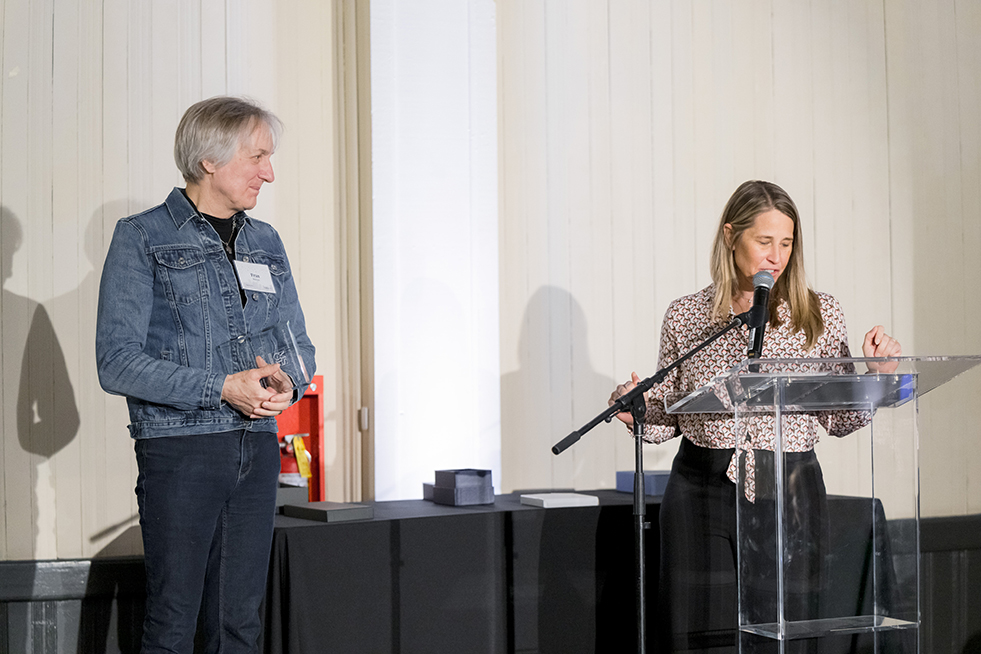
Dr. Fran Mahuta was honored at the 2026 Civil and Architectural Engineering and Construction Management Department Banquet for her contributions to the department.
Q: What prompted you to create the civil engineering program at MSOE?
FM: In 2005, ASCE released its Body of Knowledge for the 21st Century. At the time, traditional four-year civil engineering programs were not able to cover all of that material, which put additional emphasis on civil engineers to be proficient in both technical and professional skills. I designed MSOE’s program to exceed those standards while providing students the opportunity to earn bachelor’s and master’s degrees in five years. It really gave us a competitive advantage.
Q: Was it difficult to get this program off the ground?
FM: Yes and no. Faculty in my department and throughout campus were very supportive but it took the administration a little longer to realize the value. When they started talking about the idea externally, they saw the potential and we were able to move forward.
Q: The Environmental and Water Resources Laboratory brought new resources to the department. What was its impact?
FM: The lab in CC-50, while designed mainly for the civil engineering program, has equipment that serves all programs in the department for classes such as Design of Plumbing Systems, Fluid Mechanics, Principles of Environmental Engineering, and more.
The Environmental and Water Resources Laboratory, pictured above when it opened in the Campus Center in 2014, features “the sandbox,” a hydrologic modeling system designed to simulate rainfall, surface and groundwater movement. Jesse Becker ’16 was among the first students to learn in the new space, and part of the first class to receive both a B.S. in Civil Engineering and an M.S. in Civil Engineering.