“Elegant mechanical design” leads MSOE to third place robotics competition finish
A group of spring 2026 mechanical engineering graduates earned third place at the American Society of Mechanical Engineers Student Mechanism and Robot Design Competition (ASME SMRDC). The annual competition is highly competitive and invites undergraduate teams from around the world to demonstrate their ability to design and build innovative mechanisms and robots.
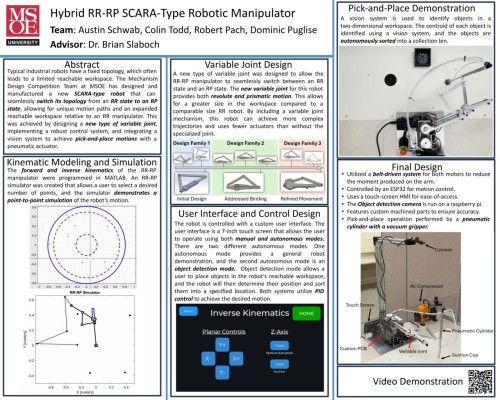
Robert Pach, Dominic Puglise, Austin Schwab and Colin Todd developed a new type of reconfigurable industrial robot for pick-and-place applications. The group added a variable joint mechanism that enabled their robot to achieve more complex trajectories. Their design has the potential to improve the flexibility and efficiency of industrial assembly tasks.
“This project stood out for its elegant mechanical design,” said Dr. Brian Slaboch, associate professor in the Mechanical and Industrial Engineering Department and advisor for the team. “The team created more than 20 prototypes of the robot’s joint switching technology, refining the mechanism through repeated testing and iteration. The result was a highly elegant and well-engineered final design.”
This year marked the first time MSOE entered the competition, making the third place finish an exceptionally exciting achievement. The team was invited to Houston, Texas to present their work to industry experts and academic researchers at the 2026 ASME International Design Engineering Technical Conferences and the Computers and Information in Engineering Conference.
The team developed the robot for their senior design project and represented the Mechanism Design Club, a new organization at MSOE focused on developing innovative mechanisms and robots to compete in the annual ASME SMRDC. Students in the club this year are building on last year’s successes with two new projects: one focused on developing a reconfigurable drone with a variable geometry frame, and a second involving the design of a 90-degree pick-and-place mechanism for fixed automation applications.
The Mechanism Design Club provides students with opportunities to apply engineering principles through hands-on design, prototyping and testing of new mechanisms and robots. Students interested in getting involved are encouraged to attend one of the club’s weekly meetings held every Tuesday from 12–1 p.m. in SG-01, located in the Allen-Bradley Hall of Science. The club is advised by Slaboch and Dr. Milad Tatari.