
From small-town classrooms to advancing cancer research
Growing up in a small town in northern Wisconsin, Savannah Duenweg ’20, Ph.D. never imagined that one day her work would help shape the future of prostate cancer treatment.
With just 16 students in her graduating high school class—and only five classmates in her science course—she benefited from teachers who knew their students well. Her science teacher recognized Duenweg’s aptitude for STEM and encouraged her to pursue engineering. During her senior year, a classroom project involving bionic eyes sparked an interest in biomedical engineering.
When it came time to choose a college, Duenweg and her mother toured MSOE. She immediately felt at home.
“I wanted to go away to college, but not be too far from home,” she said. “I liked the small campus, the small class sizes, and the opportunity to build relationships with professors.”
Those relationships would prove invaluable.
Duenweg admits the transition to college wasn’t easy. In high school, she had been a student who rarely needed to study. College was a different story.
“I passed my first chemistry exam pretty easily, then completely bombed the second one,” she recalled.
Determined to improve, she spent 12 straight hours studying for the exam retake, only to fail again.
Instead of giving up, Duenweg leaned on her professors.
“They all made time for me,” she said. “They genuinely wanted me to learn. They celebrated every success, no matter how small, and helped me understand the material.”
Those experiences taught her resilience and showed her what a supportive academic community could accomplish. She credits MSOE with helping shape the person and researcher she has become, and she still counts her freshman roommate among her closest friends today.
Although Duenweg knew biomedical engineering was the right major, she also discovered just how broad the field could be.
“In the biomedical engineering program, you learn a lot about a wide variety of areas within the industry,” she said.
That changed during her senior year when she enrolled in a medical imaging course taught by Dr. Olga Imas ’99, professor. The class introduced her to a specialty that immediately captured her interest.
As graduation approached, Duenweg interviewed for a medical imaging position, but then the COVID-19 pandemic brought hiring to a halt. Entry-level opportunities disappeared almost overnight, leaving her searching for a new path.
Then an unexpected opportunity arrived.
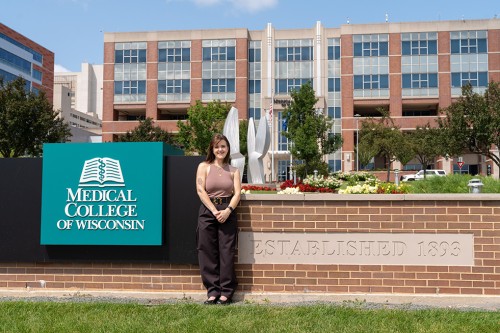 Dr. Jeff LaMack ’97, biomedical engineering program director, shared a graduate research opening in the Department of Radiology at the Medical College of Wisconsin. Graduate school, and especially pursuing a Ph.D., had never been part of Duenweg’s plan. But she took a chance, interviewed for the position, and was accepted.
“I haven’t looked back since,” she said. “It has been a great experience.”
Working under principal investigator Dr. Peter LaViolette, Duenweg completed her Ph.D. in Biophysics with research focused on using MRI data, digital pathology and machine learning to improve prostate cancer detection and risk assessment. Her work developed radio-pathomic models that connect medical imaging with tissue pathology, helping researchers better understand how tumors behave and how imaging can reveal critical information before treatment.
During her undergraduate years at MSOE, artificial intelligence and machine learning weren’t yet an integral part of her program’s curriculum. But she did learn a significant amount of coding and using MATLAB which gave her the tools she needed for her graduate research and led to her current job.
Today, Duenweg continues her work as a research scientist in the same radiology laboratory where she completed her Ph.D.
 Her research uses artificial intelligence and machine learning to predict whether prostate cancer is likely to recur or spread after treatment. By aligning pre-surgical MR images with pathology data from tissue samples, her team is creating highly detailed probability maps that can identify areas at greater risk for recurrence.
The approach represents a significant shift in how prostate cancer may be managed. Traditionally, physicians have relied largely on qualitative interpretation of medical images. Duenweg’s team is developing quantitative tools that can support more precise diagnoses and enable targeted radiation therapies and other personalized treatments—helping improve outcomes while reducing unnecessary treatment.
Reflecting on her journey, Duenweg says one lesson from MSOE has stayed with her more than anything else.
As students, she and her classmates often joked about the “MSOE Mindset” because they heard about it so frequently. It wasn’t until she entered graduate school that she truly appreciated what it meant.
“MSOE graduates are always asking questions,” she said. “We’re always exploring and driven by analysis, whether that’s through math or hypothetical thinking.”
She believes that mindset has distinguished her throughout her career.
“The MSOE Mindset rounded me out as a researcher and helps me push the boundaries of where—and how far—I can take my career.”
Outside the classroom, Duenweg embraced campus life as a founding member of MSOE’s women’s rowing team and an active participant in the Society of Women Engineers (SWE) and Biomedical Engineering Society (BMES). The friendships she built through those experiences remain some of her strongest today.
Looking back, Duenweg sees a clear connection between the supportive environment she found at MSOE and the work she does now: asking difficult questions, pursuing innovative solutions, and contributing to research that has the potential to improve lives.
For the student who once sat in a five-person science class in northern Wisconsin, it’s a journey that began with encouragement, was strengthened through perseverance, and continues today at the forefront of medical imaging and artificial intelligence.