
MSOE alumnus Behrgen Smith named finalist for prestigious Hertz Foundation Fellowship
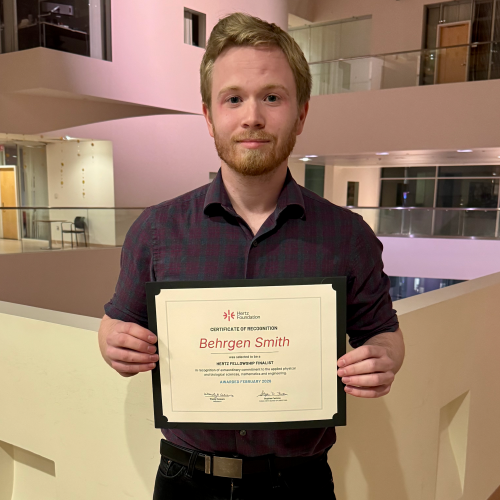 Behrgen Smith has become the first alumnus in MSOE history to be named a finalist for the prestigious Fannie and John Hertz Foundation Fellowship. A 2023 graduate from the BioMolecular Engineering program, Smith is now in contention for one of the nation’s most distinguished awards for graduate students in science, engineering and mathematics.
Smith was chosen from a pool of more than 1,450 applicants nationwide, advancing to a group of just 54 finalists who will take part in a final round of interviews with members of the Hertz Foundation’s selection committee.
Hertz Fellows receive up to five years of fully funded support, giving them the freedom to pursue bold, innovative research projects throughout their graduate studies.
After graduating from MSOE, Smith began his career as an Engineering Scientist in the Computational Chemistry department at Congruence Therapeutics in Montreal, Quebec, Canada. He is currently pursuing a Ph.D. in Biochemistry and Structural Biology at Stony Brook University in New York, focusing his research on biophysical methods for drug discovery and exploring how computational tools can sharpen and extend experimental insights.
Smith presented on this topic in his talk “Modeling with Meaning: Responsible AI for Drug Design,” during the AI in Healthcare: Transforming Patient Care and Innovation session at MSOE’s annual AI Week conference in 2025.
“I focused on how AI and machine learning are supporting drug discovery by accelerating hit finding, lead optimization and candidate selection,” Smith said of his presentation. “While AI can significantly reduce the time and cost of early-stage development, it is most powerful when paired with a foundational understanding of biology, chemistry, and physics. Responsible use of AI requires acknowledging the boundaries of our models, working closely with experimental teams, and treating computational methods as tools to inform and empower—not replace—real-world science.”
The Hertz Foundation will announce the recipients of the 2026 Hertz Fellowship in May. Committee members evaluate candidates not only for academic excellence, but for their potential to become leaders capable of addressing some of society’s most pressing challenges—from steering responsible AI innovation to advancing clean energy solutions and pioneering new cancer therapies.
The foundation notes that the competition is extraordinarily rigorous, and being named a finalist reflects exceptional promise in both research capability and future impact.
For more than 60 years, the Hertz Foundation has played a key role in fostering American scientific and technological leadership. Its more than 1,400 Fellows include Nobel laureates, MacArthur Fellows, Breakthrough Prize winners, and recipients of the Turing Award, Fields Medal, and National Medals of Science and Technology. Collectively, Hertz Fellows have founded over 375 companies, hold more than 3,000 patents, and have contributed significantly to the creation of science and technology jobs across the country.
Smith’s journey from the classrooms of the BioMolecular Engineering program to the forefront of computational drug discovery stands as a testament to the MSOE mindset. The entire university community congratulates him on this remarkable achievement and looks forward to following his continued contributions to the field of biochemistry.