MSOE student takes first place at MedTech Conference Robotics Competition
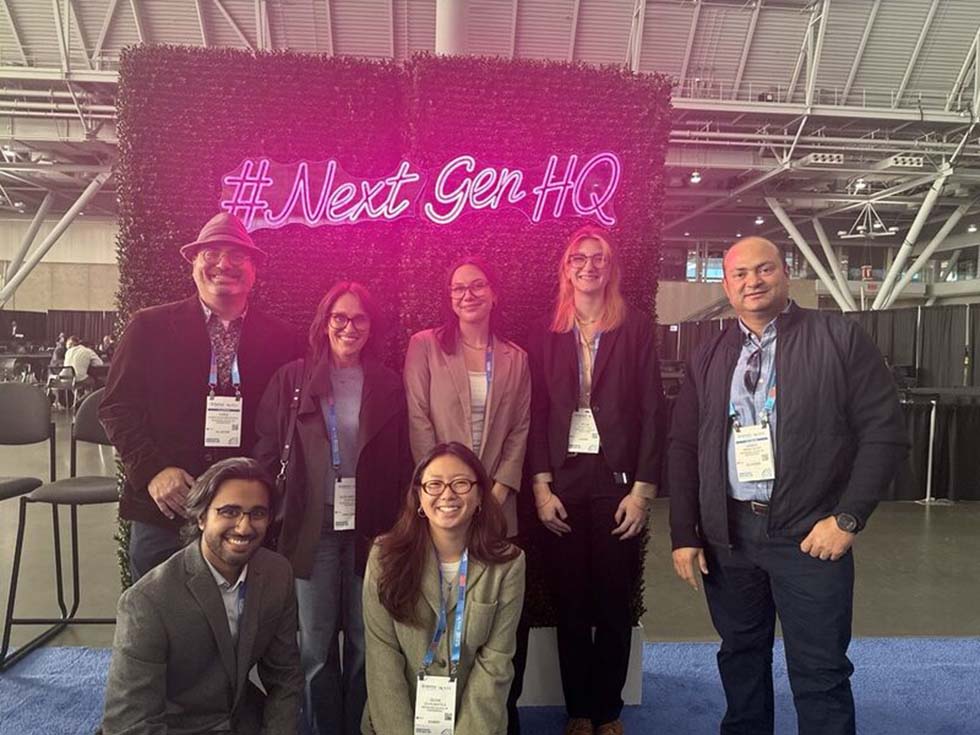
Senior biomedical engineering major Olivia Bartels was one of four MSOE students who attended the annual MedTech Conference in Boston, Massachusetts. The conference brought together global leaders in medical devices, diagnostics, imaging and digital technologies.
Bartels had the opportunity to compete in the #NextGen Robotics Challenge, a one-day competition to answer the question: how might we better integrate patient-specific preoperative planning into intraoperative surgical decision making for hip femoroacetabular impingement (FAI)? FAI, or hip impingement, is caused when abnormal bone shapes in the hip joint cause pinching at the ball and socket during movement.
Her team included students from Columbia University, Northeastern University and the University of California – Berkeley. The four of them collaborated to develop a solution using an artificial intelligence model to detect colored clay on a bone structure using a real-time camera system. The program would highlight excess bone in green and mark important areas to avoid in red.
“While in reality, excess bone is not orange clay; our prototype demonstrated the concept of AI-assisted surgical guidance,” said Bartels. “Our application to the real world would be to train an AI model with typical and standard bone anatomy and dimensions allowing it to detect the growth as a deviation. We focused on making our system AI assisted but ultimately stressing human decision making.”
The team presented their project to a group of executives and industry leaders from top medical device companies such as Stryker and Zimmer Biomet, ultimately earning them first place in the competition.
“Seeing the professionals interact with our prototype, ask questions and show curiosity validated our effort throughout the day.”
In addition to Bartels and other MSOE students—Josephine Dobbs, Rylee Hull and Nachiket Khambholja—MSOE faculty members Dr. Chris GauthierDickey, Dr. Olga Imas and Dr. Ahmed Sayed were in attendance.
“Conferences like MedTech give our students a chance to learn about cutting-edge medical device development and advancements in bioengineering, while also building valuable connections with industry professionals for their future careers,” said Dr. Olga Imas, professor and director of applied AI education. “Events such as the #NextGen AI surgical robotics competition take that even further, letting students engage with peers from other institutions and showcase their technical skills on a national stage.”