MSOE students take first and second place at Physical AI Hackathon
Two MSOE teams took first and second place in the inaugural Physical AI Hackathon.
The event, held in partnership with University of Wisconsin-Milwaukee’s Connected Systems Institute (CSI), Milwaukee School of Engineering, Rockwell Automation and NVIDIA, challenged student teams to pick one of three challenges from a real factory testbed: vial inspection, fluid mixing or robotic grasping and sorting. Teams developed and tested solutions using NVIDIA AI tools, Rockwell Automation control systems and the CSI’s industrial automation production line.
Team V, a group comprised of all MSOE international students, won by creating a self-inspecting robotic assembly cell trained in a digital twin that ran on a real FANUC industrial robotic arm.
- First place: Team V (MSOE)
- Yuktha Koganti, Shritej Gunda, Venkat Reddy Karri, Aditya Miryala, Koushik Cherukuri, Khushal Lingamaneni, Thanvi Gorrepati and Levi Eloy Santos
- $3,000, a DGX Spark and $1,000 in Brev credits
- Second place: LineWatch (MSOE)
- Reagan Burkemper, Cameron Delpage, Hayden Fons, Zoe Kirkman, Srijan Kumar, Josiah Matthews, Alayna Ostler and Austin Koske
- $1,500, an RTX 5080 and $1,000 in Brev credits
- Third place: Machine Minds (UWM)
- Souvik Roy, Erphan Ahmmad Bhuiyan, Md Robiul Islam, Nayan Banik, Asif Al Zubayer Swapnil
- $1,000, an RTX 5070 and $1,000 in Brev credits
The other three finalists, who received $500 and $1,000 in Brev credits, included:
- Code Crusaders (UWM)
- Zara Omosun, Anthony Harvey, Prabhnoor Bal and Matthew Vang
- IRIS (MSOE)
- Andrew Bieber, Asher Jaenchen and Peter Gerrits
- VYFLARE (UWM)
- Cloud, Jefferson, Ryan, Amy, Nadia, Jeremy, Toua and Nova
Throughout the evening, other hackathon participants presented their projects in a large-scale poster session with four teams awarded $250 for their projects.
The Physical AI Hackathon was the largest hackathon hosted by either institution and marks the first time UWM and MSOE students have had access at this scale to CSI’s industrial AI production line. 42 teams and a total of roughly 270 submitted their final projects to vie for the top prize.
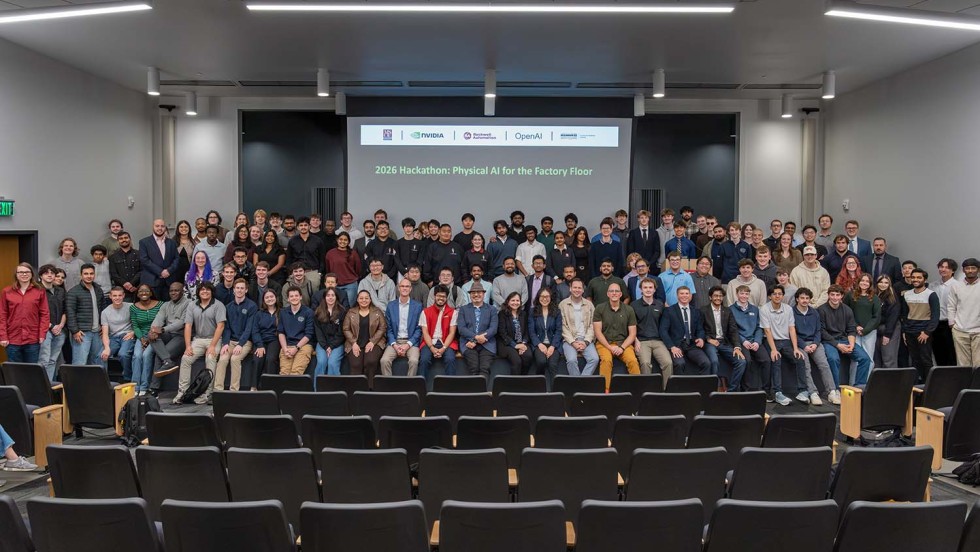
All participants in attendance pose together with the judging panel.
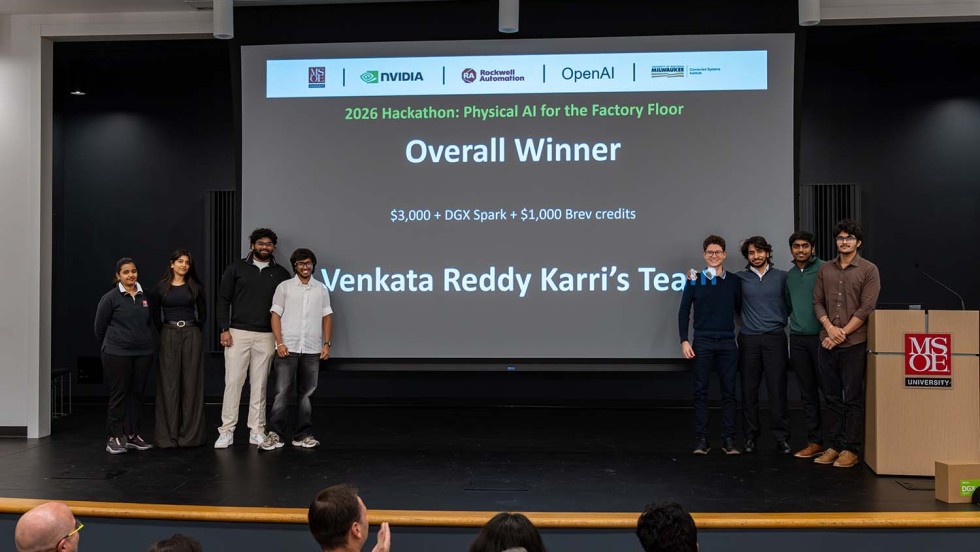
First place – Team V (MSOE)
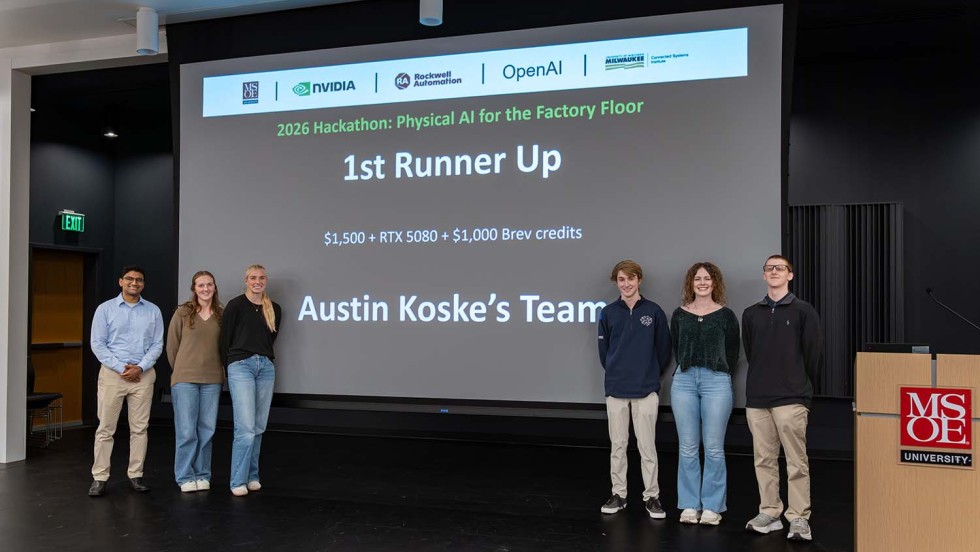
Second place – LineWatch (MSOE)
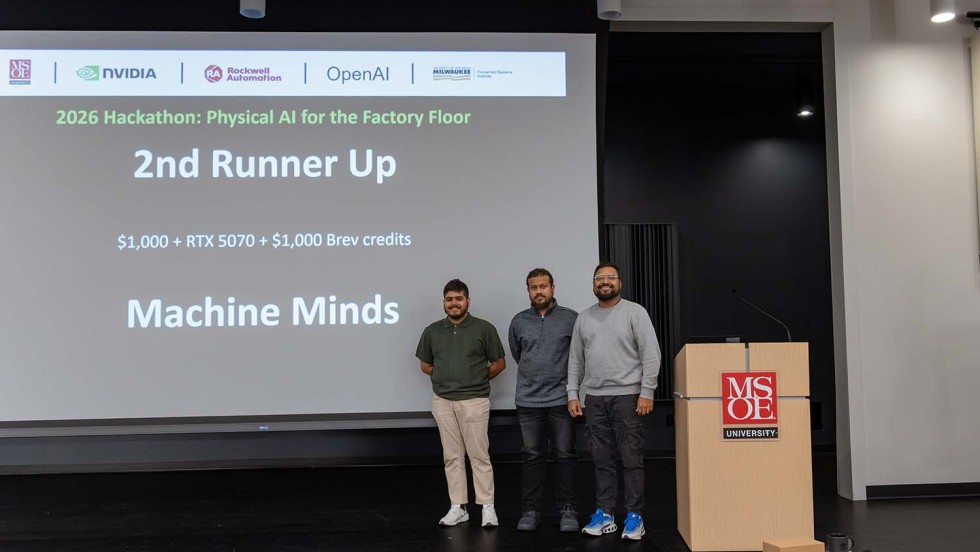
Third place – Machine Minds (UWM)