
Students share work at Undergraduate Research Showcase
Students showcased their research projects at the Undergraduate Research Showcase on Thursday, Jan. 29 at 12 p.m. in Diercks Hall. The event was dedicated to highlighting the outstanding work conducted by undergraduate students across all disciplines. Learn more about projects in the abstracts below.
MSOE Undergraduate Research Showcase
Multilayered Magneto-Dielectric Electromagnetic Absorbers for Improved Oblique Incidence Performance
Samuel Salazar
This work focuses on modeling the oblique incidence performance of absorbers; in particular, the observed shifts in resonant frequency, degradation of absorption properties, and changes in bandwidth. By developing analytical models relating absorber performance to angle of incidence, it is possible to predict and control the angular dependence. The goal of this work is to apply these models to create angularly insensitive EM absorbers. Several examples are considered including a multilayered absorber leveraging magnetodielectric materials, which can achieve a reflection coefficient of at least -20 dB exceeding 60 degrees of incidence angle for both TE and TM polarizations.
Utilizing space-based images to quantify and mitigate blending systematics in ground-based galaxy cluster mass measurements
Holden Truman
The forthcoming Legacy Survey of Space and Time (LSST) will provide imaging of the skies at unprecedented image depth and drive major advancements in the field of weak lensing (WL). However, greater image depth will lead to an increase in the number of blended sources, especially in galaxy cluster fields with large source densities. Much work has been done to address the issue of blending using simulated images, though these methods must be verified with observational data and more work focusing on blending in cluster fields is needed. Free from atmospheric contamination, space-based imaging allows for better source separation and therefore can be used as a reference for source identification in ground-based imaging. The galaxy cluster A2390 is an Early Release Observations (ERO) target of the Euclid space telescope for which we have high-quality wide-field five-filter photometry from Subaru. We’ve utilized the Euclid ERO data to identify roughly 2000 previously unrecognized blends in our Subaru imaging of A2390.
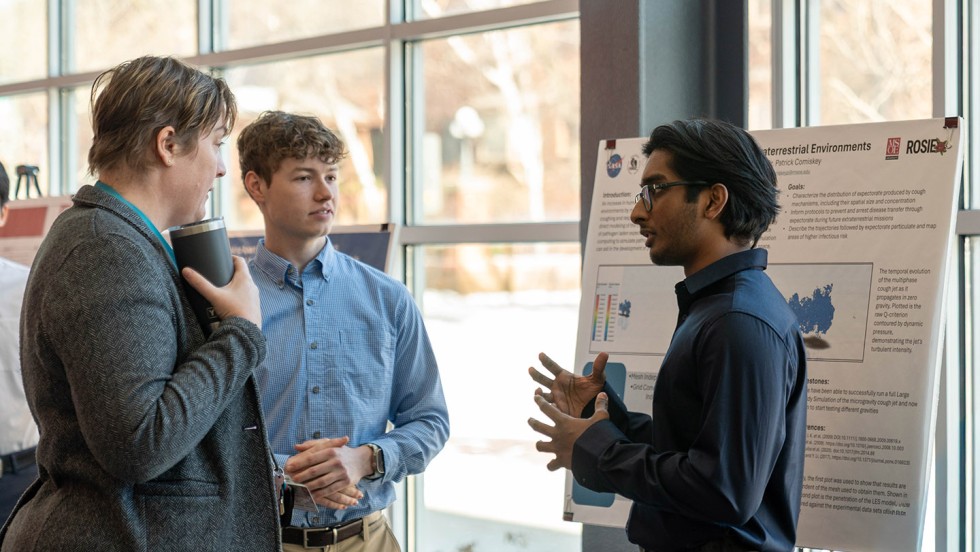
Extraterrestrial Multi-phase Cough Jet Transport
Rishikesh Katta, Noah Reynolds
The increase in frequency of manned and commercial spaceflight has led to greater risk of extraterrestrial disease transmission by means of tumultuous expiratory mechanisms. Unresolved current lapses in analysis of turbulent multiphase jet propagation in microgravity may allow for unchecked infectious disease transmission on isolated spacecraft. Current research, focused on the distribution and trajectory of the turbulent terrestrial expiratory jet has determined that, with earth-like gravities, particulate matter from violent expectorate events like coughing or sneezing can remain suspended for more than 9 hours, reaching radii greater than 7 meters from the source. However, there remains limited research into the propagation of the cough jet in microgravity, leading to gaps in knowledge in extraterrestrial particulate-enabled disease transport. This research aims to investigate the trajectories, spread, distribution, and final states of infectious expectorate-laden multiphase microgravity turbulent jets produced by cough mechanisms with computational fluid dynamics simulations run on Rosie. The goal is to allow for the identification of areas of higher infectious risk and determination of effective extraterrestrial disease-containment protocols. The mouth opening for a cough is estimated by a 4 cm2 circular opening, and the jet is simulated using a cuboidal region meshed with approximately 5 million cells. The particulate phase, defined using an experiment-derived tabular distribution, is released at the peak velocity time of the cough jet, to account for cases with widest particle distribution. To model the fluid phase of the cough, a species model is used to specify turbulent axisymmetric humid jet, issuing from the inlet (mouth) in a non-uniform, experimentally derived velocity distribution.
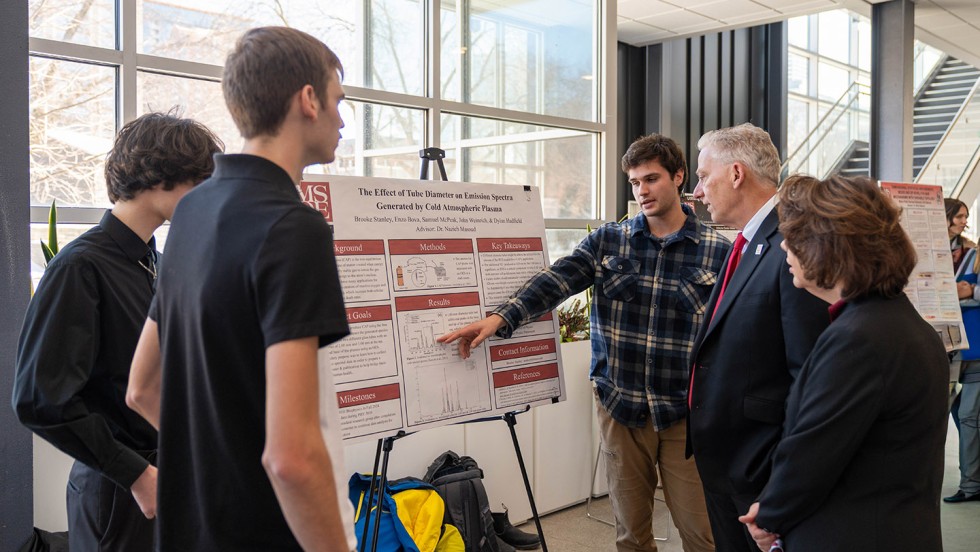
Emission from a tubular cold atmospheric plasma source at different diameters
Enzo Bova, Dylan Hadfield, Samuel McPeak, Brooke Stanley, John Weinrich
Cold atmospheric plasma (CAP) is the non-equilibrium version of the fourth state of matter created when energy is provided to a relatively stable gas to ionize the electrons while providing little energy to the atom’s nucleus. Plasmas at atmospheric pressures find wide spread technological use in the life sciences and in environmental, biological, and medical applications (e.g. for disinfection, surface modification for biopolymers, wound healing etc.) One of the most widely used areas of application of plasmas is the production of reactive species (Oxygen reactive species (ORS) and Nitrogen reactive species (NOR)) and light (from the visible region of the electromagnetic spectrum to the ultraviolet (UV) and vacuum ultraviolet (VUV)). Ultraviolet light, and the reactive species, have more than 3 electron volts (eV) of energy, allowing them to break chemical bonds, and thus can be used for sterilization of contaminated air, water and surfaces; ozone production; skin treatment, and both clinical and cosmetic (tanning) treatments.
The purpose of this study is to compare the plasma species generated by CAP using helium gas at two different glass tubes with an exit diameter of 2.00 mm and 1.00 mm. The emission spectra from the tubes at the tip, middle, and base of the plume will be investigated using an Optical Emission Spectroscopy.
Movie Profit Prediction
Michael Phillips
The goal of the project was to learn the basics of predictive modeling using real-world data. First, we learned how predictive models work, the different kinds of models, and how to implement them. Then, we applied the models to real-world data. We chose movie data from the IMDb and TMDB databases. Applying the models required cleaning the data. This process involved removing rows with empty values, rows with no budget or runtime value, and rows with no release date or cast. We also limited our data to movies released between 2015 and 2024. After removing the rows, we eliminated the columns that were not used in the model. These included the ID (a row ID that became useless after removing the rows), status (whether the movie was released, in production, or canceled), original title, overview, tagline, spoken languages, director of photography, and poster path (a link to the poster image). This process reduced the number of rows from ~1,000,000 to ~3,000. After removing the unnecessary rows and columns, we added columns to show profit (revenue minus budget), the number of "top" actors in the movie (compared to a separate list of "top 100 actors"), three columns for the genres, the average number of times the director appeared in the cleaned dataset (the average was taken when there was more than one director), a dummy variable to indicate if the movie was released in English, a dummy variable to indicate if the movie was released during the holiday season (December), and a dummy variable to indicate if the movie was released during the summer. We created three models: a linear model, a random forest model, and a support vector machine model. We used RMSE (root mean squared error) and 5-fold cross validation to compare the models. We tried to predict three target variables: profit, IMDb rating, and vote average (another average of user ratings from 0 to 10). In general, the random forest model performed best when compared to the other models' RMSE.
Index Properties of Traditional and Polymer Modified Bentonite
Ada Parker, Emily Ross, Ellysa Shay, Kevin Akins
This research contributes to our understanding of bentonite barrier performance under variable chemical-hydraulic-thermal-stress conditions and material enhancement. This work is a collaboration between Milwaukee School of Engineering (MSOE), Villanova University and UW-Platteville (UW-P), and includes investigating the properties of bentonite clay amended with polymer exposed to various stressors (e.g., chemical, hydraulic, thermal). Research was conducted on two commercially available bentonite clays, MX80 and CG50, with Resistex and Universal polymer amendments. The following index tests were performed: Swell Index, Viscosity, and Fall Cone, following ASTM Standards. The results of these index tests are compared to the transport properties (e.g., hydraulic conductivity (k) and diffusivity (D*)) of the clay measured at Villanova to see if the index tests can be used to predict the more difficult to measure transport properties.
Use of flow meter signal separation to facilitate model calibration in sanitary sewer hydrology
Cocoro Wachi
Sanitary sewer hydrology models typically use signals such as rainfall and temperature to replicate a flow metering signal. Once a sewer hydrology model is calibrated, an artificial long-term sewer flow signal can be generated for use in continuous simulations of sewer systems. Sewer hydrology modeling efforts recognize these different signals and address them in distinct model components. The distinct model components are summed and compared to the flow meter signal. The issue with this approach is that each component of the model has a number of parameters, all of which must be adjusted replicate just one signal. The undergraduate research project investigates separating sanitary sewer flow signals into the four distinct components through the use of digital recursive filters. This allows calibration of each distinct sewer model component to its own signal. This approach yields a benefit of a reduction of many orders of magnitude of the possible solution domain of the model parameters. This speeds model calibration, makes calibration more accurate, and reduces the magnitude of the parameter joint confidence region.
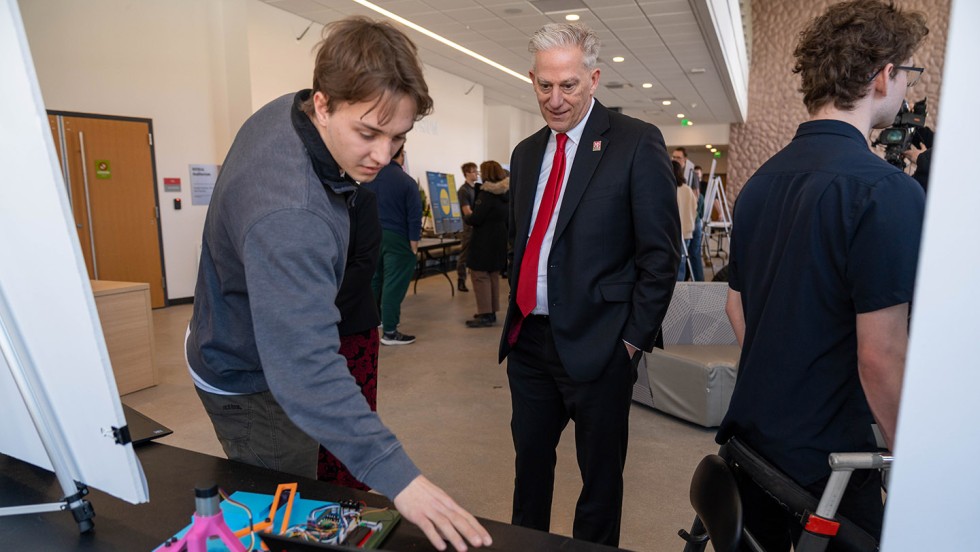
Dimensional Synthesis, Kinematic Modeling, and Prototype Validation of a Novel Five-Bar Mechanism with Variable Topology for Pick-and-Place Applications
Myles Pratt, Rachael Klamecki, Erik Sakuma
This project presents a mechanism with variable topology for industrial pick and place tasks. Industrial pick and place systems traditionally require multiple actuators to achieve a complex pick and place motion. This work introduces a five-bar mechanism with variable topology that achieves a complex pick-and-place motion using a single actuator. Compared to a typical pick-and-place system with multiple actuators, the proposed mechanism has the potential to reduce power, weight and cost of the system. The work presents the mechanism dimensional synthesis, kinematic modeling, and a proof-of-concept physical mechanism prototype. The results of the work include a graphical user interface that may be used by mechanism design engineers to evaluate the use of the five-bar mechanism with variable topology early in the design process. A physical prototype was also built to demonstrate the physical motion and practicality of the mechanism. The new mechanism may be applied broadly across industries, but it is best suited for manufacturing and aerospace applications.
Measuring Consequential States via Counterfactual Backwards Induction
Adrian Manchado
In reinforcement learning (RL) an AI agent is represented as a policy—a function that takes in an observation of the world and produces a probability distribution over possible actions. The goal of RL algorithms is to shape this policy using data so that the AI agent makes optimal decisions over a long time horizon to manage complex problems. In this project, we seek to identify consequential moments of agent choice, measure their relative magnitude, and leverage this information to improve the sample efficiency of RL algorithms. We propose measuring consequential moments by comparing the distributions over the return associated with different actions at a given state. We introduce a novel, conceptually simple, simulation-based, policy-agnostic algorithm to estimate these return distributions, which we call counterfactual backwards induction. We apply this algorithm to the StarCraft Multi-agent Challenge (SMAC) benchmark environment and test a variety of metrics (e.g. KL divergence, etc.) for return distribution comparison. Preliminary empirical results from the SMAC indicate that this approach is an effective way to identify particularly important moments of agent choice.
Architecting Transparency: Measuring the Structural Origins of Bias on ROSIE
Theresa Kettner
This research proposes a strategic "pivot" from black-box auditing of existing models to a white-box mechanistic interpretability approach. By acting as an architect rather than a consumer, I am developing a custom nano-scale transformer model designed to serve as a "transparent microscope" for training dynamics. To ensure maximum transparency and performance, the model is implemented in C++/CUDA, bypassing high-level framework bloat to allow for direct memory control and maximum throughput. The core of this investigation lies in a controlled A/B dataset strategy executed on the ROSIE supercomputer. The study aims to answer a critical research question: Does gender bias behave like early-stage memorization or late-stage generalization, a phenomenon known as "grokking"? By tracing the exact training step where bias emerges, this project seeks to define a "Time-to-Bias" curve. This replaces ethical ambiguity with an observable engineering metric, enabling us to measure and understand the structural origin of bias from the first optimization step.
Honors Program Servant Leadership Projects Fall 2024 – Fall 2025
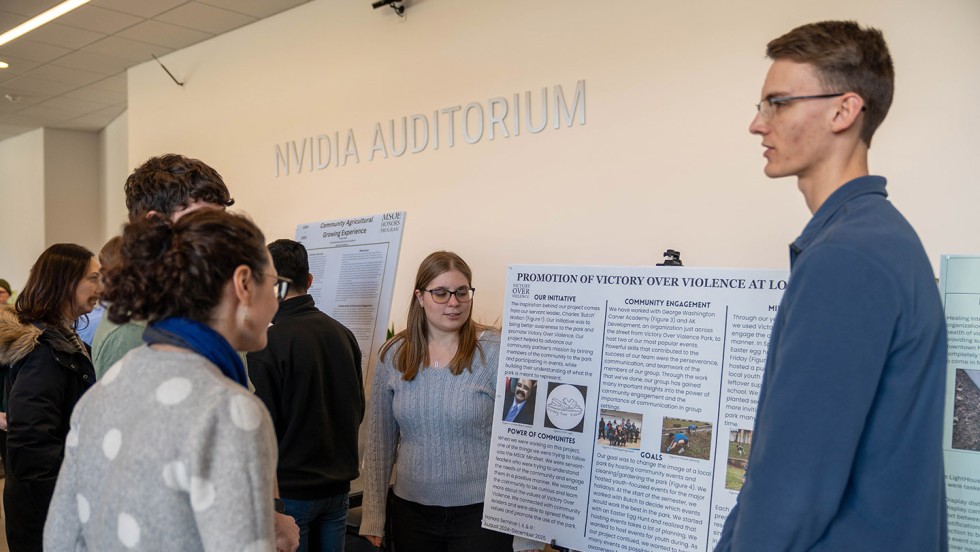
Victory Over Violence Park (VOV)
Honors Program students partnered with Charles “Butch” Walton to raise awareness of Victory Over Violence Park and advance Walton’s mission: “Every time a group or individual commits a positive act against violence, we achieve Victory over violence.” They accomplished this by building relationships within the community, connecting with local leaders, collaborating with organizations, and hosting events.
Community Agricultural Growing Experiences (CAGE) Community Garden
Honors Program students collaborated with CAGE Executive Director Andre Lee Ellis and CAGE youth gardeners to advance the organization’s mission: to grow food and provide resources and programming that enhance the everyday lives of all people. Their work spanned a range of projects, including designing a Healing House and outdoor kitchen, conducting soil testing, and more.
Healing Intergenerational Roots (HIR) Wellness Institute
Honors Program students partnered with counselors and staff at the HIR Wellness Institute to support their mission of providing free, accessible mental health care, wellness services, and victim advocacy for Indigenous and underserved survivors of violence. Through volunteering, students learned about the community they served and contributed to projects such as developing a volunteer provider-connection app, supporting marketing efforts, and designing a sensory wall for the institute’s headquarters.
"Our City of Nations” (OCON) Conference
Honors Program students worked with the Bureau of Refugee Programs, the International Institute of Wisconsin, and Medical College of Wisconsin to aid in the planning, execution, and evaluation of their annual conference. Their mission is focused on ways to protect the rights and address the needs of persons in forced or voluntary migration worldwide and support their transition to a dignified life. We came together to strengthen relationships across sectors and understanding of all newcomers.
Hawthorn Glen Healing Garden
Honors Program students partnered with Menominee Tribal Enterprises (MTE), the Milwaukee Public Museum (MPM), Milwaukee Institute of Art and Design (MIAD), and UW-Madison M.S in Design and Innovation to conduct ecological research and develop garden designs. This initiative began with Menominee Tribe’s dedication to sustainability and their traditional values, with a focus on creating nature-centered community spaces like gardens to support their practices. As the project evolved, MKE Recreation’s Hawthorn Glen emerged as a site of opportunity rooted in community and education. The goal was to create an accessible Healing that incorporates Indigenous ways of knowing and fosters meaningful interactions with nature.
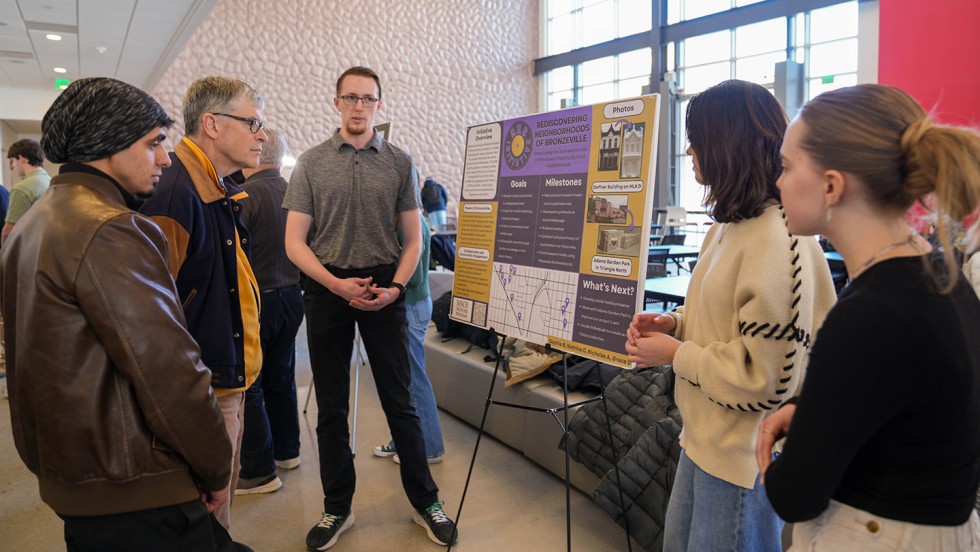
Adams Garden Park (AGP) – Rediscovering Neighborhoods of Bronzeville (RNB)
Honors Program students worked to document the past and present of Milwaukee’s Bronzeville community in an effort to revitalize the area’s history and create a shared collective of experiences. The team explored innovative ways to document and represent buildings and structures (sometimes demolished) using tools such as 3D modeling and 3D printing. This project allowed students to engage with community-centered storytelling by highlighting neighborhood narratives, local businesses, and the lived experiences of residents.
Home to Stay & The Community
Honors Program students collaborated with Shannon Ross and Adam Procell to advance their efforts supporting returning citizens, helping ensure individuals reentering society have the tools and resources needed to rebuild their lives. The project began as a website and mobile app designed to provide access to reentry services for people recently released from prison. Students contributed to real-world components of the Home to Stay project and engaged with partner organizations to better understand effective pathways for support.
Texiguat, Honduras Museum Development
Honors Program students worked with MSOE faculty and community leaders in Texiguat, Honduras, on the development of a online museum website dedicated to the town’s history and culture. Project initiatives included video marketing to introduce the museum concept, creation of a website for Texiguat, and the development of an interactive online museum. The work also supported plans for a physical museum to be housed within the historic headquarters (cuartel general) of General Francisco Morazán.
MacCanon Brown Homeless Sanctuary
Honors Program students collaborated with community leaders such as Sister MacCanon Brown and other community partners on the development of the MacCanon Brown Homeless Sanctuary, a multi-resource center that provides a toolkit of resources to the people served, building and its surrounding campus. Their work included projects focused on urban agriculture (both indoor and outdoor), renewable energy, and related initiatives.
Vel Phillips Juvenile Justice Center School
Honors Program students partnered with staff and instructors at the Vel Phillips Juvenile Justice Center School (Wauwatosa, Wisconsin) to design and deliver workshops focused on STEM skill development and the creation of educational virtual reality experiences.