
Nearly 100 student projects to take center stage at MSOE showcase
 Milwaukee School of Engineering will host its annual Senior Project Showcase on Friday, May 15 and will feature nearly 100 projects. Throughout their senior year, students collaborate with classmates on a final project related to their degree program. It’s an opportunity for them to take everything they’ve learned in their time at MSOE and put it to use in a real-life application. The projects are often sponsored by companies looking to solve a problem, and others are driven by a student’s interests.
Projects will be on display throughout campus:
- 10 a.m. to 2 p.m. – Civil and Architectural Engineering and Construction Management Department
Campus Center, ground floor, 1025 N. Broadway - 11 a.m. to 2:30 p.m. – Dwight and Dian Diercks School of Advanced Computing
Dwight and Dian Diercks Computational Science Hall, 1025 N. Milwaukee St. - 11 a.m. to 2:30 p.m. – Electrical, Computer and Biomedical Engineering Department
Walter Schroeder Library, second floor, 500 E. Kilbourn Ave. - 11 a.m. to 2:30 p.m. – Humanities, Social Science and Communication Department
Dwight and Dian Diercks Computational Science Hall, 1025 N. Milwaukee St. - 11 a.m. to 12 p.m. – School of Nursing
Campus Center, Admissions Event Space, 1025 N. Broadway - 11:30 a.m. to 1:30 p.m. – Physics and Chemistry Department
Campus Center, second floor, 1025 N. Broadway - Noon to 3 p.m. – Mechanical Engineering Department
Science Building and Werwath Mall, 432 E. Kilbourn Ave.
A sampling of projects is below. A complete list and more information can be found online: msoe.edu/senior-projects.
Here are a few examples:
Litter Bot
Computer science students are taking on Milwaukee’s litter problem with a high-tech solution: a semi-autonomous robot designed to pick up trash. Built on a four-legged robotic platform, the “Litter Bot” uses a camera and artificial intelligence to spot common waste, then uses a robotic arm to grab and remove it. The system can adapt to different types of litter, learning how to pick up everything from cups to wrappers. The goal isn’t to replace human crews, but to support them—helping keep streets and public spaces cleaner, one piece of trash at a time. Location: Diercks Hall, 11 a.m. to 2:30 p.m.
Sensory-Enhanced Myoelectric Prosthesis
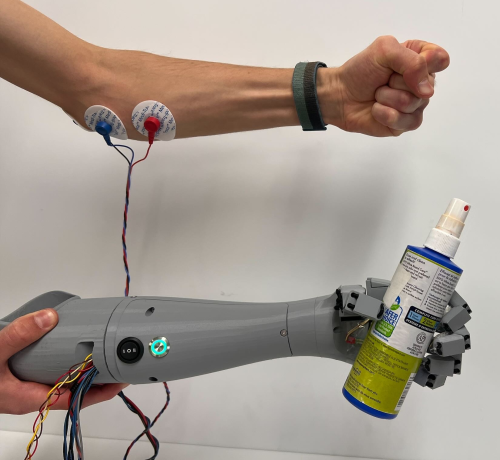
A team of three biomedical engineering students built a 3D-printed myoelectric prosthetic hand for transradial (below-elbow) amputees. This next-generation prosthetic hand can both move and provide a sense of touch—creating a more natural experience for users. The hand can be controlled in two ways: by using muscle signals from the upper arm, or through a sensor-equipped glove that mirrors each finger’s movement. Built-in sensors in the hand detect pressure and position, sending feedback through gentle vibrations and skin movement to help users understand how tightly they’re gripping and where their hand is positioned. The goal is to make prosthetics more intuitive, responsive and accessible for people living with limb loss. Location: Walter Schroeder Library, second floor, 11 a.m. to 2:30 p.m.
AI Aphasia Therapy
A team of computer science students has developed a new app designed to help people with aphasia— a condition that affects speech after a stroke or brain injury—practice communication skills on their own. The app uses artificial intelligence to understand and evaluate speech, even when it’s incomplete or hard to interpret. It gives real-time feedback during simple naming exercises and tracks progress over time. With an easy-to-use design, patients can practice anytime, while clinicians can monitor results remotely. The goal is to expand access to speech therapy beyond the clinic and help improve recovery outcomes. Location: Diercks Hall, 11 a.m. to 2:30 p.m.